
keep your curiosity sacred oh comely magazine
subscribe

Issue sixteen's here! To get a copy, pop into WHSmiths or one of our independent stockists or buy it here.

We peeked into the mundane and extraordinary secrets of other people's lives: a father and son who decorated their walls with colouring pencils and the team of costume-makers in the National Theatre's dye room. Below: "Silly Man" by ten-year-old Eemil.

We froze fruit, taste-tested fried chicken, hopped on houseboats and dug up garden-themed goodies to give away.

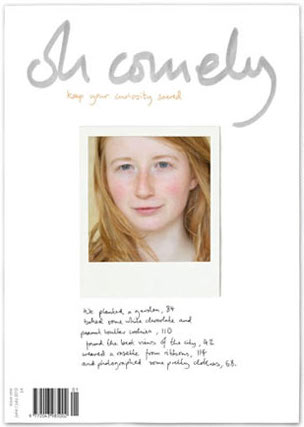
We also gave our cover a redesign; let us know what you think at subs@ohcomely.co.uk.

secret arts
words rosanna durham
17th June 2013
art

"It’s important that creative festival crews are seen as worthy artists in their own right." So says Tess Acheson, director of Secret Arts, the foundation behind the ingenious and otherworldly installations that Secret Garden Party festival is known for.

Every year, Secret Arts accepts proposals from designers for large-scale art installations to be built at the festival. In 2011 alone, they awarded £80,000 of funding to the production of these works. This infamously included a mammouth helium balloon called 'Is Land', which was shaped like a lush chuck of floating greenery. Its tie was cut during the festival, leading the balloon to drift away and spark a worldwide hunt for its whereabouts.

2013's festival, you won't be surprised to hear, is set to match its preceding parties in ambition and artistic ingenuity. The theme is Superstition and its curators are asking all Gardeners (as the revelers are nicknamed) to explore the supernatural, inexplicable and irrational through the art works on show, yes, and other potions like summer sun, good company and late-night dancing. What follows is a selection of art installations you can expect to see.

Starting with the more delicate and temporal of the bunch is 'The Street', from two 2012 Central St Martins graduates, Katy Beveridge and Fernando Laposse. They're presenting a floating city of 100 illuminated paper houses. This ghostly city street will be invisible by day and rise majestically from the lake at night, when it lines the lake's central footbridge.

Brighton-based ceramicist Alice Walton has a cute project planned called 'The Wish Bone Wishing Well'. She's hiding a wishing bowl deep in the Grange Farm forest containing hundreds of hand-cast ceramic wishbones. Festivalgoers can pick them out and make a wish.

But I particularly like the sound of 'White Death: An Electromagnetic Detox'. Because if you've ever speculated what effect electromagnetic waves have on your innards (well, these guys have) you'll be aware that a faraday cage is one place to escape them. Secret's faraday is being built by a team of Cambridge architects. It'll be surrounded by aerials that will modulate those same electromagnetic currents, turning them into a musical set piece.

Finally, and perhaps most unorthodox of all, is an installation from the newly-formed artists collective, Les Merchants. Called 'Lûz', it's a huge mirrored pyramid that contains brightly-coloured patterns on the inside. As viewers move inside the structure, so they'll trigger a change in the interior's pattern.

It sounds like being trapped in a kaleidoscope to me, but Secret Garden Party is all about bottling rainbows, or partying from the effort, so I don't doubt that it will be a memorable thing. Find more about the project on the team's Kickstarter page, where they are chasing funds to finish.

Secret Garden Party 2013, 25th-28th July. secretgardenparty.com.

Issue 16 has landed and with it our second Craft Club brief. This month there are oh comely subscriptions and online craft tutorials courtesy of The Amazings to be won, so listen up!

In the issue, Alice Morby showed us how to make a notebook using the traditional art of Japanese stab binding. The technique's beauty is in its infinite variations: from fluro stitching to aged paper, you can make each notebook exactly how you want.

Here's your challenge: make a personalised notebook with a stitched spine.

The prizes: four craft tutorials and four Oh Comely subscriptions.

How to enter: Email craft@ohcomely.co.uk or tweet #OCcraftclub by July 1st.

Following Alice’s instructions, you’ll produce the traditional tortoise-shell bind that creates a diamond pattern along the notebook spine. Once you've mastered the basics there're plenty more patterns and techniques to experiment with – including four-hold binding shown here by a crafter at Design Sponge.

To top that, for this Craft Club, we've teamed up with the lovely folks at The Amazings, a craft community of wise elders eager to share their mastery and wisdom with budding creatives. We're giving away 4 of their newly-launched online 'How to Make an Altered Book' tutorials, which teach you how to transform a dusty old book into a work of art, just like this one below.

Rather inspiringly, The Amazings’ aim is to keep the traditional skills and practices of yester-year alive by teaching them to the new, young crafters of today. They have a resident Italian glass artist, a Scottish Kiltmaker, a Spanish crocheter, and classes range from learning to play the ukulele to creating retro hair do’s.

Their new online master classes include over 2 hours of entertaining how-to videos, teacher’s notes and handouts, and the opportunity to connect with classmates and ask the teacher questions. It’s rather like going back to school, except you get to swap the textbooks for well, fun stuff! Check out The Amazings website for the full range of classes and courses taught by lifelong crafters and makers.

For your chance to win a subscription and enrollment on a master class, email your finished notebook to craft@ohcomely.co.uk by 1st July, or tweet it with the tag #OCcraftclub.

From the 28th-30th June the International Ceramics Festival will be returning to the mid-Wales coast, at Aberystwyth University. Since it first began some 26 years ago, the three-day festival has now become the UK’s leading ceramics event offering teachers, students, artists and collectors to meet and discuss the work of some of the finest ceramicist and potters in the world. 

Alongside lectures and selling exhibitions will be practical demonstrations by leading artists keen to show their skills and techniques to audiences from their personal work spaces – encouraging spectators to ask questions and discuss. And because we’re definitely pro curiosity, we thought we’d take a look at some of the artists who’ll be taking part at the festival. Visit the International Ceramics Festival for more.

Keiko Masumoto

Keiko is currently the V&A’s resident Japanese ceramics artist and has always found great inspiration in historical decorative Asian ceramics and cultural tradition. Most of her works have a strong sense of heritage, while also serving as functional objects. ‘Castle Pot’ is an example of the way in which Keiko combines the vessel and decorative motif, subverting the traditional in such a way that the motif becomes the form, and the vessel the decoration.

 ©Keiko Masumoto Castle Pot

Watch Keiko practice the techniques used in her Motif series at the festival, and also catch her at the V&A where she opens her studio weekly to visitors, and runs a programme of ceramic workshops, including a weekly ceramics workshop for families during the summer holidays and a clay hand-building workshop series for blind and partially sighted visitors. Find out more here.

Beth Cavener Stichter

Currently a full-time studio artist in Washington, Beth is known for creating dynamic, emotionally charged animal and human figures to reveal hidden patterns in behavior and inner struggles. She investigates the “primitive animal instincts lurking in our own depth.” ‘The Golden Netted Hare’ for example, seems at first just a feral animal suspended, and yet as part of her collection embodies “the impacts of aggression, territorial desires, isolation, and pack mentality.”

©Beth Cavener Stichter The Golden Netted Hare

Monika Patuszynska 

A ceramics artist and president of the International Ceramics Symposium “Porcelain Another Way”, Monika is committed to emphasising the shift from creative process to the final object. She describes her work as being about, “slip casting, chasing accidents, always checking what is through the looking glass.”

 ©Monika Patuszynska Chinese Stories 2010 from the series Transforms

Watch her at the festival where she’ll be sawing a mould into parts, reassembling the broken parts, casting the mould and then revealing the creation.

Takeshi Yasuda

Takeshi trained at the Daisei-Gama Pottery in Mashiko, where he opened his first studio. His work in celadon-glazed porcelain takes great influence from the strongest force on Earth: gravity. Rather than fight against it, Takeshi embraces the force, his ‘Unfolding’ series features collapsed forms which have been hung upside down to stretch them back as they dry, and for his ‘Folding’ series he allowed the forms to slump while being fired in the kiln. 

©Takeshi Yasuda

Conor Wilson 

With a modest but growing international profile, Conor is currently focusing on the process of making and the value of skill, leading to his research into making, writing and the sites at which such processes occur. He looks at the poetic approach to material and language, and his playful pieces explore the ongoing concern of making a living in an unequal and over-exploited world.

©Conor Wilson Monkey Chipp 

wish list 9
words amy bonifas
14th June 2013
fashion

You’re taking an afternoon stroll through the woods to the tune of some beautiful birdsong, the sun’s shining and you’ve got your new wellies on. Suddenly, you’re so charmed by the moment that you want in on the melody. And we’ve just the thing: the Bird Call Trio set (£37.50) from Cow&Co – this handcarved set includes three wooden instruments designed to mimic the tuneful calls of the Goldfinch, the Great Tit (yep) and the Nuthatch. There’re instructions and tips for calling these little beauties so that you might call your own bird army to attention if you fancy, one which hopefully doesn’t transform into a terrifying Hitchcockian nightmare. Watch out for the flapping, ahh!

But seriously though, we’re very happy this exists – buy it at Cow&Co, or upgrade to the Bird Call Quartet (£43) if you want to take things further.

Fancy a free dram of whiskey and learning about how this most delicious of brews is made? We've got 10 pairs of tickets to a talk at the Balvenie Whiskey Féte in London this Saturday that promises just that.

Held at the New Craftsmen in Bloomsbury, you'll learn from Balvenie's David Stewart about the finely-tuned process of whiskey making, from choosing a cask for single-barrel malts, to the concept of sequential maturation. He'll then talk you through a tasting. Following that, you'll be sipping a Balvenie Caribbean Cask 14yr!

Natalie Melton, from New Craftsmen, will also be there discussing her work with British craftsmen. It’s an appropriate pairing, since Balvenie’s whiskey draws heavily on traditional methods of making and by-hand processes. 

To win, write to free@ohcomely.co.uk, or share this link over on Twitter.

Meet The Maker: A New Craftsmen and David Stewart talk: Saturday 15th June, 17.00-19.00, The Balvenie Whisky Féte, Tavistock Square Gardens, London.

A child prodigy who eventually became the highest-paid entertainer in the world, Liberace led an extraordinary life. However, Steven Soderbergh’s film Behind the Candelabra eschews biopic trappings in favour of a claustrophobic portrait of the deeply dysfunctional relationship between the famed pianist and ingénue Scott Thorson (Matt Damon).

Introduced by a mutual friend (an impressively-moustachioed Scott Bakula), Michael Douglas’ Liberace seduces Scott not just with his opulence and fame but with sustained attention of a sort that the orphaned Scott is unaccustomed to. Based on Thorson’s tell-all book – published shortly after Liberace’s death from an AIDS-related illness in 1987– the film follows their relationship as it is slowly corrupted by Liberace’s controlling nature and Scott’s spiralling drug abuse.

Forced to transform himself with plastic surgery into looking like a younger version of Liberace, Scott becomes addicted to “the California diet”, regularly imbibing a medicine cabinet’s worth of prescription drugs peddled by surgeon Rob Lowe (whose Afghan Hound haircut and surgery-ruined face steal the film entirely). As Scott turns to selling Liberace’s gifts to pay for his habit and his gentle nature is consumed by strung-out tetchiness and paranoia, Liberace’s quenchless thirst for sex and control leads him to increasingly dangerous trysts.

Soderbergh, an intellectually curious filmmaker who often marries his talents with a passion for experimentation, once again demonstrates that he can be at his strongest when giving the audience exactly what it expects. There is little that will surprise in the narrative – from the moment we see Liberace’s soon-to-be-former-boyfriend Billy Leatherwood (Cheyenne Jackson) rolling his eyes and disconsolately picking at his dinner we’re aware that Scott is following a path where many other handsome, impressionable young men have already trod – but the unavoidable journey of seduction and disenchantment is given power by how well written and performed each scene is.

Scott and Liberace’s relationship is doomed from the start, and accordingly the film is a compelling exercise in horror as their love brings out each other’s worst qualities on the march to an inevitably painful conclusion, all while they destroy their bodies with plastic surgery and prescription drugs.

Even after an acting career of more than forty years, Douglas' performance is revelatory. Caring, creepy, needy, fatherly, and predatory, his portrayal is empathetic towards the character and yet uncompromisingly savage at the same time. He is equally matched by Matt Damon; despite being too old for the part (Scott started his five-year relationship with Liberace when he was 17), Damon is similarly as good as he’s ever been.

At the heart of their performances the pair conveys a genuine love that perseveres in spite of everything else. Both Scott and Liberace crave adoration and use the other to attain it, but even as their behaviour plumbs new depths the film has sympathy for them and the destructive cycles they’ve found themselves in.

Behind the Candelabra deftly veers between comedy and tragedy, but nestled within is an earnest argument about the legal rights of homosexuals in long-term relationships. Despite being ultimately damaging for both of them, Scott and Liberace’s relationship was a marriage for all intents and purposes, and yet Scott ends up with few legal rights at the end of it. More even than the plastic surgery or drug abuse, the inability to express their relationship openly is what truly mars their lives.

For all of Liberace’s wealth and success, he was unable to escape the experience shared by all gay men of his era. Forced to pretend he was straight, Liberace spent his life trapped in a lie, one perpetrated not just by himself but by everyone who knew him – from his manager concocting imaginary love affairs and suing gossiping journalists to his audience, deluding themselves about his sexuality in order to embrace his work at a time when the idea was unthinkable.

Richard LaGravenese’s screenplay doesn’t beat the audience over the head with the point, but builds it naturally into the story (a beautiful little scene where Scott sees Liberace’s autobiography in a bookshop years later and finds that it’s essentially a work of fiction.) In a film which features such gloriously flamboyant costume design and heavy prosthetics depicting the horrors of plastic surgery, its quiet moments are often the most powerful.

“Have you got any plans for tomorrow?” asked my boyfriend. “I’m going to learn Jacobean stitching!” was my somewhat unexpected reply. Amused as he was by the idea of me embroidering a ruff for myself, I was hugely looking forward to the day course, which is run by the Royal School of Needlework in the beautiful grounds of Hampton Court Palace.


Having been to William Morris’ Red House the day before (a highly recommended outing too, arts and craft fans) and been inspired by the embroideries on show, I was already in the mood for some sewing of my own. Making my way down the palace path in the morning sunshine and up to the tallest tower overlooking the gardens was enough to put anyone in the mood for a genteel day of needlecraft.

The course was run by a couple of graduates from the Royal School of Needlework who guided us through a Jacobean sampler of trellis stitch, French knots, woven wheels and seeding whilst the beautiful examples on the walls around us were a reminder to keep our stitches neater than the topiary in the gardens below.


There was a real mix of ages in the class, as we shared crafting confessionals, and there was plenty of back-patting and encouragement, making it a lovely environment to try your hand at something new.

Before I went completely cross-eyed there was an hour for lunch in which we were free to roam the grounds too. After a traditionally Tudor BLT in the cafe I took a walk round the stunning courtyards and gardens and tried to avoid the advances of Henry VIII. For anyone with a love of needlework this is a wonderful day out.

The school runs both day classes and longer courses throughout the year, with full details of their programme available to look at here.